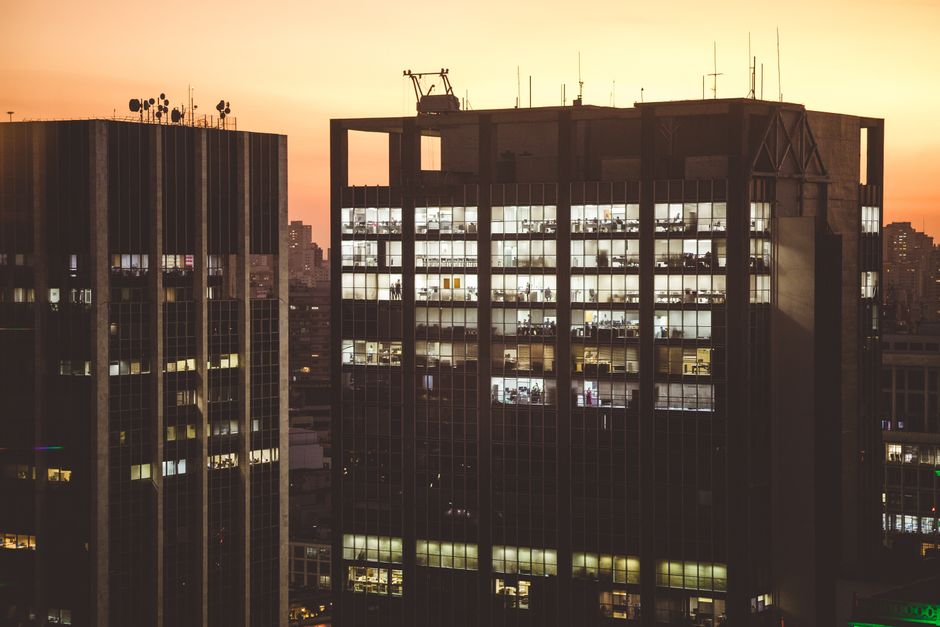
Boston's office market is turning. After four years of relentless pressure on landlords — emptied floors in the Financial District, sublease signs multiplying along the Seaport's Congress Street corridor — the numbers are beginning to move the other way. Vacancy in Greater Boston's core office market dipped to roughly 18.2 percent in the second quarter of 2026, down from a post-pandemic peak of nearly 21 percent in late 2024, according to data compiled by commercial brokers tracking the market. The retreat is modest. But in a market this size, modest matters.
The timing is not accidental. Life sciences — Boston's most reliable economic anchor — has absorbed a correction of its own after the 2022–2023 lab-space building binge, and companies that survived the funding squeeze are now signing leases again. Meanwhile, AI and defense-adjacent tech firms are hunting for Class A space in a city that offers both talent density and proximity to institutions like MIT and Harvard. The convergence of those two forces is creating something that has been scarce since 2020: genuine competition for the best blocks of space.
Where the Deals Are Happening
The Seaport District remains the headline address. Buildings like 111 Harbor Way and the Vertex Pharmaceuticals campus along Fan Pier Boulevard set the standard for what corporate tenants want — floor plates above 40,000 square feet, LEED certification, and walking distance to South Station. Asking rents in the Seaport are holding at $85 to $95 per square foot annually for premium space, barely budging from 2023 levels despite the broader market softness. That stability itself is a signal.
Back Bay is a different story, and in some ways a more instructive one. The stretch of office inventory along Boylston Street and around Copley Square saw significant sublease dumping through 2023 and 2024, as financial services firms right-sized. That overhang is now clearing. Sublease availability in Back Bay fell by approximately 340,000 square feet between January 2025 and June 2026, leaving a tighter market than most observers predicted this time last year. Smaller tenants — boutique asset managers, tech-enabled professional services firms — have been the primary beneficiaries, signing deals at effective rents 15 to 20 percent below pre-pandemic asking prices after landlord concessions are factored in.
Cambridge's Kendall Square corridor, predictably, never really softened. BioMed Realty and Alexandria Real Estate Equities control significant portions of the lab and office inventory there, and their buildings along Main Street and Binney Street carry waitlists. Kendall lab space is transacting at north of $120 per square foot annually — a number that would have seemed implausible for any American city outside Manhattan five years ago.
Who Is Already Winning
The clearest beneficiaries right now are mid-size tenants with lease expirations falling in the 2026–2027 window. They have enough leverage to extract meaningful concessions — free rent periods of six to nine months, substantial tenant improvement allowances — while still securing space before the supply picture tightens further. Several firms in the 20,000-to-50,000-square-foot range, particularly those in fintech and professional services, have structured deals in the Prudential Center complex and along High Street in the Financial District that would have been impossible to negotiate in 2019.
For investors, the math is sharpening too. Distressed assets — buildings that changed hands at steep discounts when regional banks pulled back on commercial real estate lending through 2024 — are attracting interest from opportunistic funds headquartered in New York and London. At least two office towers in the downtown core traded below $200 per square foot in the past 18 months, less than replacement cost by a wide margin.
The practical message for Boston businesses with lease decisions approaching: the window for maximum negotiating leverage is probably 12 to 18 months wide. Landlord concessions are generous now precisely because absorption has not yet outrun available supply. By late 2027, if current trends hold, that calculation flips. Companies sitting on the fence should be in conversations with brokers today, not after the next round of signed leases removes their best options from the board.